
|

The right cap can dramatically improve the performance of a container! Qorpak has all of the options to suit your business. It’s as easy as 1, 2, 3!
Glass or Plastic – which is better for your application? Selecting the correct material for your package is important to ensure product compatibility. Evaluate these factors when determining the material and style of container.
| Glass | Plastic |
|---|---|
| Impervious to permeation of gases | Recyclable |
| Rigid | Durable |
| Recyclable | Variety of Resins |
| Chemically Inert | Impact Resistant |
| Autoclavable | Light Weight |
| Glass Container Styles | Plastic Container Styles |
| Boston Rounds | Boston Rounds |
| French Squares | Cylinders |
| Graduated Medium Rounds | Jugs |
| Jugs | Modern Rounds |
| Standard Wide Mouths | Oblongs |
| Straight Sided Rounds | Packers |
| Vials | Squares |
| Wide Mouth Packers | Straight Sided Rounds |
| Vials | |
| Wide Mouth Rounds | |
| Types of Glass | Plastic Resins |
| Type I Borosilicate Glass | HDPE - High Density Polyethylene |
| Type III Soda Lime Glass | LDPE - Low Density Polyethylene |
| Safety Coated Glass | PET - Polyethylene Terephthalate |
| PP – Polypropylene | |
| PS – Polystyrene | |
| PVC - Vinyl/Polyvinyl Chloride | |
| Common Glass Colors | Common Plastic Colors |
| Flint (clear) | Natural (translucent) |
| Amber - light sensitive (brown) | White |
| Cobalt Blue – light sensitive | Clear |
| Green – light sensitive | Amber – light sensitive (brown) |
| Optional Glass Cleaning Processes | Optional Plastic Cleaning Processes |
| Ready to Clean | Metals |
| Semi-Volatiles | Super Cleaned |
| TOC | Ultra Cleaned |
| Ultra Cleaned | Vacuum & Ionized |
| Vacuum & Ionized | |
| Volatiles |
Click here to see our complete guide to Precleaned Process.
Qorpak offers a variety ways to purchases caps
Things to consider
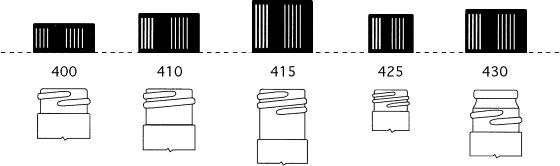
The first number refers to the cap diameter (in millimeters). The second number refers to the height and thread configuration of the closure or finish. Below is a selection of commonly used caps and finishes. Click here to see our guide to How to Select the Right Size Cap for Your Bottle.
Closure Material & Liners
Cap Materials
Thermoset and Phenolic (Bakelite) - These caps are known for providing the widest range of chemical compatibility and for being the most temperature tolerant of plastic closures. They also provide the most consistent adherence to close dimensional tolerances. Thermoset and Phenolic caps are suggested for pharmaceutical applications. Thermoset closures cannot be re-melted after they are formed. Common resins include urea, phenolic and melamine.
Polypropylene (Thermoplastic) - Polypropylene caps are known for good impact strength, cost effectiveness and pliability. They can be re-melted after they are formed.
Metal - Metal caps offer the widest range of temperature tolerances and are very resistant to fracture from impact. Metal caps are great for industrial and food applications. A metal closure is manufactured from either steel (coated with anti-corrosive coating of either chrome-plate or tinplate) or aluminum.
Cap Liners
Caps attached or Separate? Bulk packs or convenience packs? We have all of the packaging option combinations to suit your application.
*Available only for-stock items marked as convenience packs
Custom Options Qorpak can custom design or pack to your specifications. Call us at 800.922.7558 for more information