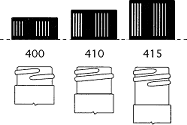
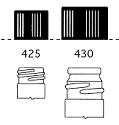
|

There are two basic types of plastic closures used for scientific applications: thermoset and thermoplastic.
Thermoset closures cannot be remelted after they are formed. They provide the widest range of chemical compatibility and they exhibit the most tolerance to temperature of all plastic closures. Because thermoset closures are rigid, they provide the most consistent adherence to close dimensional tolerances. Common resins include urea, phenolic, and melamine.
Thermoplastic closures can be remelted after they are formed. They are known for good impact strength, cost effectiveness, and pliability. Common resins include polypropylene (autoclavable) and polyethylene.
Metal closures offer the widest range of temperature tolerances and are very resistant to fracture from impact. A metal closure is manufactured from either steel (coated with anti-corrosive coating of either chromeplate or tinplate) or aluminum.